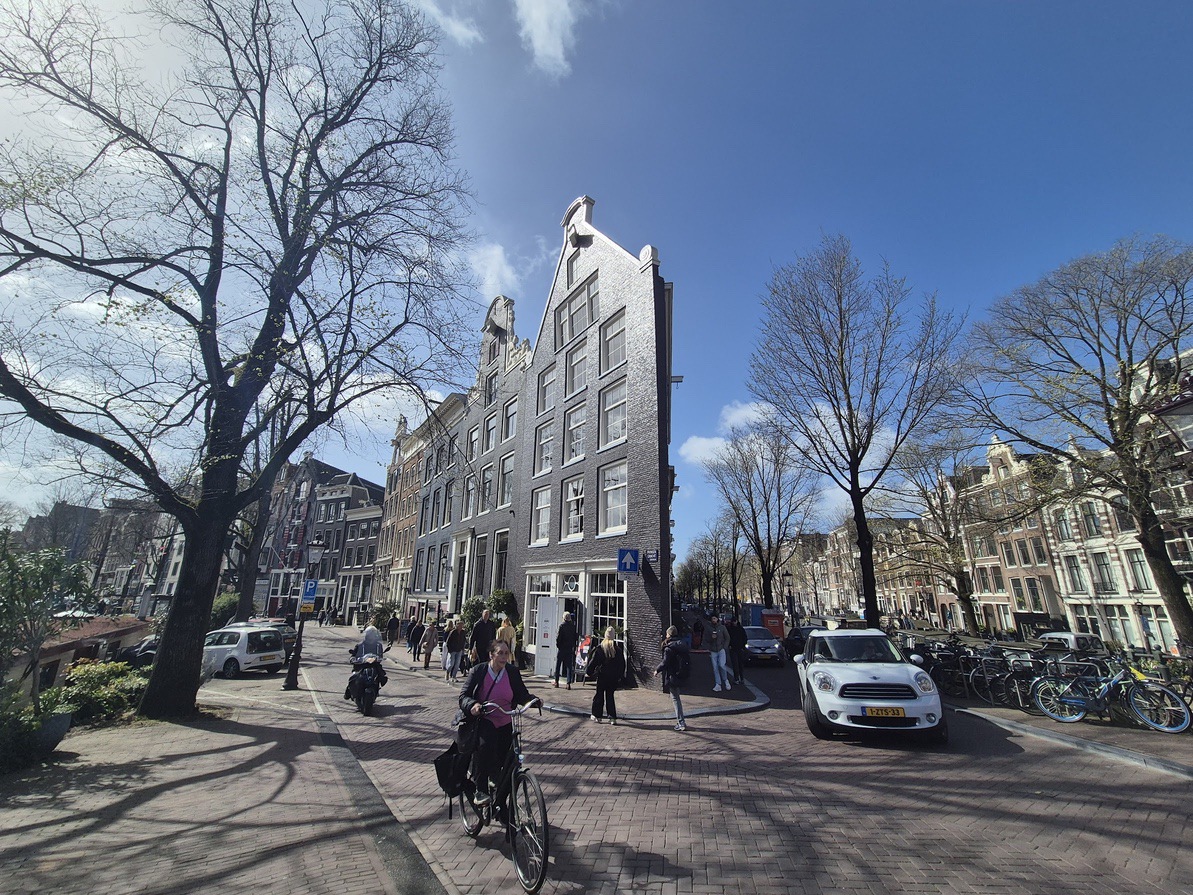

Walking through Amsterdam feels like stepping into a city that loves to play tricks on your eyes. At every corner, another house appears to be “the narrowest in the city” — buildings squeezed so tightly between their neighbors that they look almost unreal.
And that’s exactly what happened during my walk through the canals. Every turn revealed a house that looked thinner than the last. A constant game of perspective that makes you wonder: “Is this finally the one?”
It’s all about perspective
Many of these houses look shockingly narrow because of:
-
the angle you’re standing at,
-
the camera’s perspective,
-
the leaning façades (a classic Amsterdam feature),
-
and the city’s uneven ground.
Amsterdam is full of beautiful optical illusions.
The architecture behind the magic
Built on thousands of wooden piles, many houses slowly tilt with time — forward, sideways, or into each other. That’s why the city’s façades seem to dance, creating scenes that you simply can’t find anywhere else.
 The real narrowest house: Singel 7
Among all the illusions, there’s only one true champion: Singel 7. With a façade of just 2.02 meters wide and barely 1 meter at the back, it’s the official narrowest house in Amsterdam. A tiny red façade sandwiched between two bigger buildings — a slice of 17th-century history that somehow still stands.
Why so narrow?
Back in the 1600s, taxes were calculated based on the width of the façade. The wider the house → the higher the tax. So the Dutch did what the Dutch do best: they built narrow and went higher.
A city of illusions
Some houses are truly narrow. Others only seem that way. But all together, they turn Amsterdam into a city where nothing is exactly what it looks like at first glance. And maybe that’s its greatest charm: You have to walk it, explore it, and see it from different angles. Only then do you understand that in Amsterdam… everything is a matter of perspective — even the world’s narrowest house.